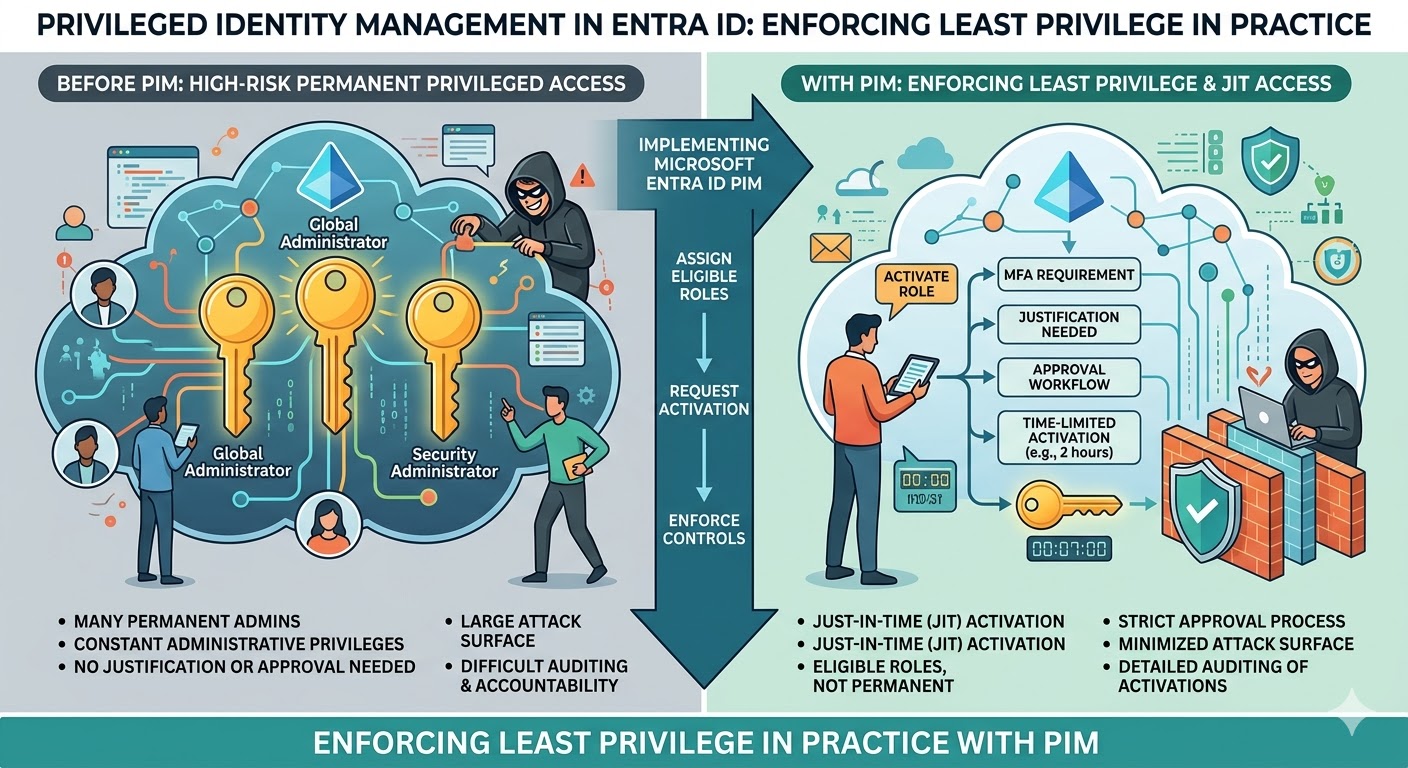
Privileged Identity Management in Entra ID: Enforcing Least Privilege in Practice
Microsoft Entra ID Privileged Identity Management (PIM) is one of the most important security controls available in the Microsoft identity ecosystem. Administrative privileges represent the highest value targets in any cloud environment. If attackers obtain persistent access to privileged roles, they can quickly move from a single compromised identity to full tenant control.
PIM is designed to reduce that risk by enforcing least privilege, just-in-time access, and strong governance controls around administrative roles.
Why privileged access is the highest risk
Most successful cloud breaches do not start with global administrator access. They start with a compromised user account, token theft, or phishing attack. Once an attacker gains an initial foothold, they attempt to escalate privileges.
Without proper controls, organizations often assign administrative roles permanently. This creates several problems:
- Privileged roles remain active even when they are not needed
- Compromised admin accounts immediately provide full administrative capability
- Auditing and accountability become difficult
- The attack surface for identity-based attacks increases significantly
Privileged Identity Management addresses these risks by ensuring administrative permissions are not permanently active.
The principle of least privilege
Least privilege is a foundational security principle. It means that users and systems should only have the permissions required to perform their tasks and nothing more.
In identity systems, this translates into several design goals:
- Minimize the number of privileged accounts
- Avoid permanent administrative role assignments
- Require approval or justification for privilege elevation
- Enforce time-limited access
Instead of having a permanent Global Administrator, a user becomes eligible for a role and activates it only when necessary.
How Privileged Identity Management works
Privileged Identity Management introduces the concept of eligible roles and active roles.
Eligible role assignment
An administrator can be assigned as eligible for a role such as:
- Global Administrator
- Security Administrator
- Privileged Role Administrator
- Conditional Access Administrator
Eligible assignments do not grant immediate privileges. The user must activate the role when they need it.
Role activation
When a user activates a role, several controls can be enforced:
- Multi-factor authentication
- Justification for role activation
- Approval from another administrator
- Time-limited activation
- Ticket number requirement
- Conditional access evaluation
This ensures that privilege escalation is both controlled and observable.
Time-limited privileges
Once activated, the role remains active only for a limited period of time. After the activation window expires, the privileges are automatically removed.
This significantly reduces the window in which a compromised identity could be abused.
Monitoring and auditing privileged access
PIM also provides detailed visibility into administrative activity.
Security teams can monitor:
- Role activation events
- Privileged role assignments
- Approval workflows
- Privilege escalation attempts
- Role usage patterns
This audit capability is critical for incident response and compliance.
Common implementation mistakes
Many organizations enable PIM but fail to fully operationalize it. Some common issues include:
- Leaving critical roles permanently assigned
- Allowing role activation without approval or justification
- Granting Global Administrator roles unnecessarily
- Not reviewing role assignments regularly
- Failing to integrate PIM with security monitoring
PIM is most effective when it is part of a broader identity governance strategy.
What a mature PIM deployment looks like
A well designed PIM implementation typically includes:
- No permanent Global Administrator accounts
- Just-in-time activation for high privilege roles
- Approval requirements for sensitive role activation
- Short activation windows
- Mandatory MFA for elevation
- Continuous review of role assignments
Combined with Conditional Access and strong identity protection policies, PIM becomes a powerful control for protecting administrative access.
Final thoughts
Administrative privilege is the most valuable target in cloud identity systems. Privileged Identity Management ensures that those privileges are controlled, time-bound, and auditable.
Organizations that adopt PIM properly reduce the risk of privilege escalation and strengthen the overall security posture of their Microsoft Entra ID environments.