Designing a Practical Microsoft Defender XDR Architecture
Microsoft Defender XDR is one of the most important security platforms in the Microsoft ecosystem, but many organizations still approach it as a bundle of products instead of an operational security architecture.
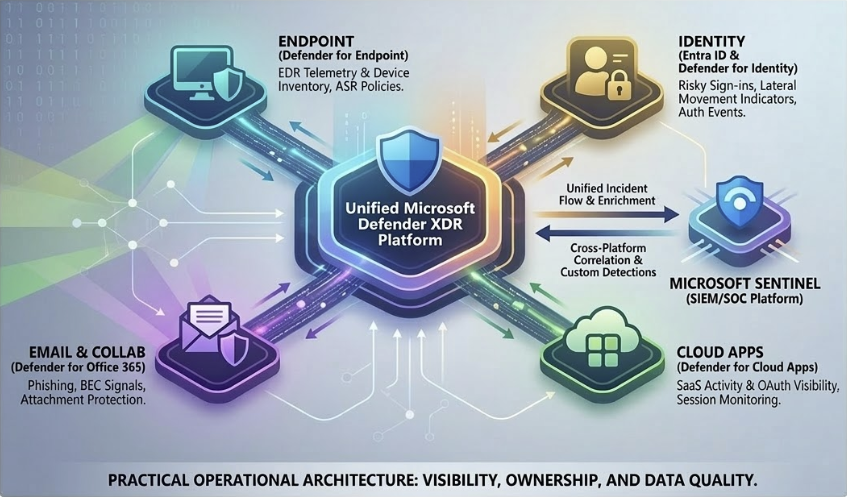
In practice, Defender XDR becomes truly valuable when it is designed as a connected platform that brings together endpoint telemetry, identity signals, email protection, cloud application visibility, and incident correlation into one investigation and response workflow.
Why architecture matters
A Defender XDR deployment can look healthy on paper while still being weak in reality. It is common to see environments where products are enabled, but ownership is unclear, onboarding is incomplete, incident handling is inconsistent, and integration with the wider SOC is weak.
A strong architecture should answer a few basic questions clearly:
- What data sources are onboarded and trusted
- Which teams own configuration, monitoring, and response
- How incidents are triaged and escalated
- How Defender XDR integrates with Microsoft Sentinel
- How identity, endpoint, email, and cloud signals are operationally connected
Core components of a practical Defender XDR architecture
Endpoint protection
Microsoft Defender for Endpoint is usually the strongest signal source in the platform. It provides device inventory, EDR telemetry, vulnerability context, attack surface reduction capabilities, and investigation data that can drive day to day security operations.
Without healthy endpoint onboarding and policy consistency, the rest of the architecture loses visibility and confidence.
Identity protection
Microsoft Entra ID and Defender for Identity add the identity layer that many investigations require. Authentication events, risky sign-ins, lateral movement indicators, and identity attack paths are critical in understanding how an attacker is operating.
Endpoint detections without identity context often tell only part of the story.
Email and collaboration security
Defender for Office 365 remains essential because many incidents still begin through phishing, malicious attachments, credential harvesting, or business email compromise patterns. Email telemetry is often the first signal in the chain and provides critical evidence for initial access.
Cloud app visibility
Defender for Cloud Apps extends the architecture into SaaS activity, OAuth applications, risky user behavior, and session level visibility. In modern hybrid environments, cloud app monitoring is not optional. It is part of the same investigation surface.
The role of Microsoft Sentinel
Defender XDR and Microsoft Sentinel should not compete. In a mature security program, they serve different but complementary purposes.
Defender XDR should usually be treated as the primary Microsoft-native detection and investigation platform. Microsoft Sentinel should act as the broader SIEM and SOC platform for cross-platform visibility, custom detections, long-term retention, orchestration, and multi-source correlation.
That means the design should be intentional:
- Defender XDR for native Microsoft detections and investigations
- Sentinel for broader SIEM operations and SOC workflows
- Clear ownership rules for where incidents are triaged, enriched, and escalated
Common mistakes
A few issues appear repeatedly in enterprise deployments:
- Incomplete device onboarding
- Weak policy standardization
- No clear distinction between platform engineering and SOC operations
- Alerting without tuning
- Poor integration with Microsoft Sentinel
- Missing validation of detection use cases after rollout
- Treating enablement as success instead of focusing on operations
What good looks like
A well designed Defender XDR architecture should provide:
- Consistent onboarding across supported platforms
- High quality endpoint and identity telemetry
- Clear ownership of policy and detection logic
- Tuned and actionable incident generation
- Strong integration with Microsoft Sentinel
- Investigation workflows that analysts can actually use
- A realistic operating model, not only a technical configuration
Final thought
Microsoft Defender XDR is not only a security product suite. It is part of a security operating model.
The organizations that get the most value from it are the ones that design for visibility, ownership, incident handling, and data quality from the start. Good architecture does not stop at product enablement. It creates a platform defenders can trust and operate with confidence.